
The Developer Who Designs Against Himself
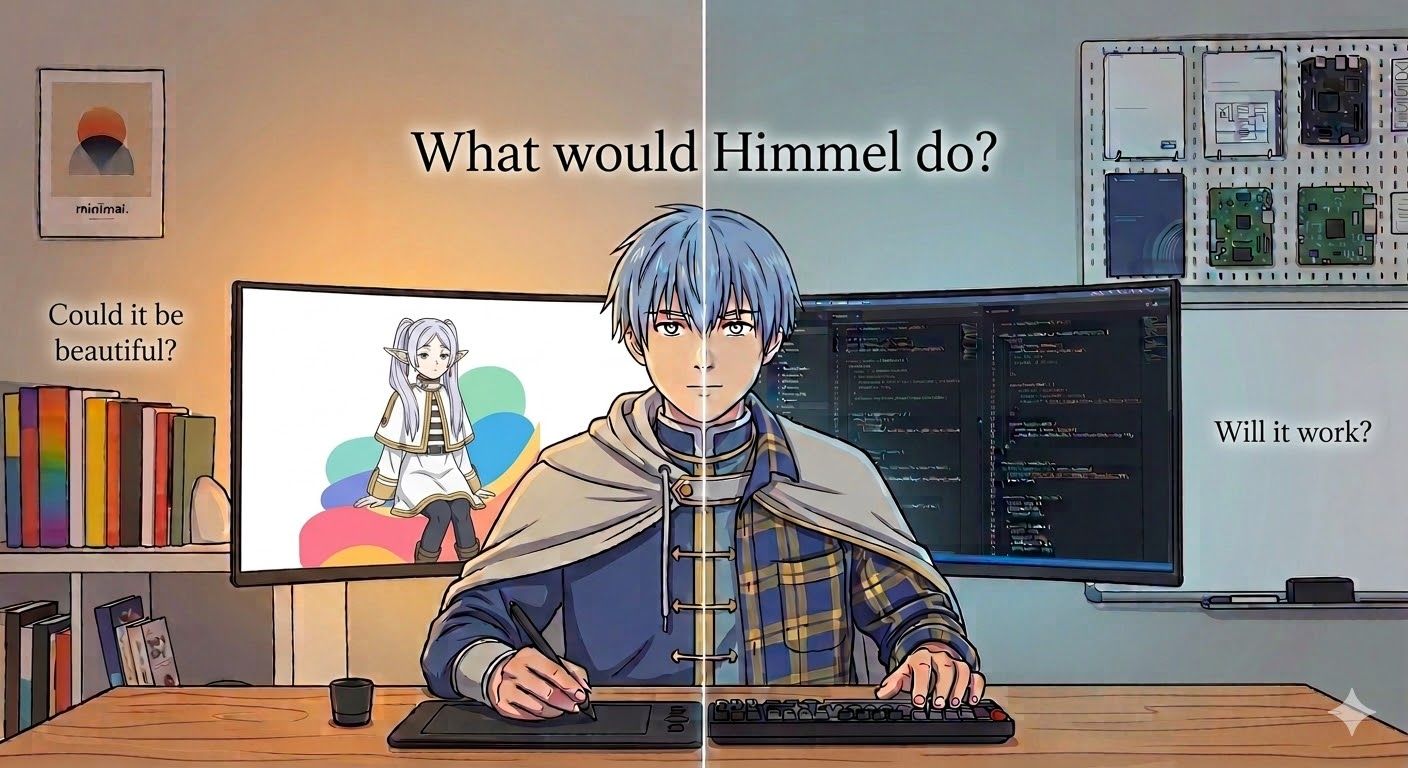
There's a specific kind of paralysis that only happens when you're both the designer and the developer.
You open Figma. You start laying out a screen. Then somewhere between placing a card component and picking a font weight, you hear it. A quiet voice that says "that animation is going to be a nightmare to implement." So you simplify it. Not because it's wrong. Because you already know what comes next.
That voice isn't a collaborator. It's you. And it never shuts up.
Most articles about the designer-developer gap talk about two people not communicating. That's a real problem, but it's not your problem. Your problem is that you communicate too well with yourself, constantly, before anything even makes it to the screen.
When I was building event management platforms, conference systems, and community tools, the earliest design decisions were never purely visual. Every component I placed came pre-loaded with a cost estimate. How many API calls does this state require? What happens when the data is empty? Does this UI even make sense if the user has 500 items instead of 5?
That awareness is a superpower. It's also a cage.
The thing no one tells you when you start designing as a developer is that constraints are not the enemy of creativity. Unchecked constraints are. There's a difference between simplifying something because you thought about the edge cases, and killing an idea before you even tried it because you were afraid of the build.
The first is good engineering judgment. The second is just fear wearing a technical disguise.
I've scrapped cleaner layouts because I mentally pre-ran the responsive breakpoints. I've avoided animations I actually liked because I started calculating bundle size in my head. None of those calls were wrong, exactly. But some of them were premature. The design never got a fair trial.
If you're a developer learning to design, here's the honest version of the advice.
Your technical knowledge is genuinely valuable. You'll design things that can actually be built. You'll catch problems that pure designers miss. Clients and teams will trust your output more because it's grounded.
But you have to learn to hold two modes at once. A design mode where you let things be ambitious, and a build mode where you negotiate them back to reality. The mistake is collapsing those two into one and skipping the first.
Give the design a chance to be wrong before you make it practical.
The gap between design and development is real. But the more interesting gap is the one inside a single person doing both, trying to figure out when to listen to which side of their brain.
That negotiation never fully resolves. You just get better at timing it.